




Lesbos (Greek: Λέσβος), sometimes referred to as Mytilini after its capital, is a Greek island located in the northeastern Aegean Sea. It has an area of 1,632 square kilometres (630 sq mi) with 320 kilometres (199 miles) of coastline, making it the third largest Greek island. It is separated from Turkey by the narrow Mytilini Strait.


Mytilene was founded in the 11th century BC by the family Penthilidae, who arrived from Thessaly, and ruled the city-state until a popular revolt (590–580 BC) led by Pittacus of Mytilene ended their rule. In early Middle Ages, it was under Byzantine and Genovese rule. Lesbos was conquered by the Ottoman Empire in 1462, who ruled the island until the First Balkan War in 1912, when it became part of the Kingdom of Greece.


History
According to Classical Greek mythology, Lesbos was the patron god of the island. Macar was reputedly the first king whose many daughters bequeathed their names to some of the present larger towns. In Classical myth his sister, Canace, was killed to have him made king. The place names with female origins are likely to be much earlier settlements named after local goddesses, who were replaced by gods. Homer refers to the island as “Macaros edos”, the seat of Macar. Hittite records from the Late Bronze Age name the island Lazpa and must have considered its population significant enough to allow the Hittites to “borrow their gods” (presumably idols) to cure their king when the local gods were not forthcoming. It is believed that emigrants from mainland Greece, mainly from Thessaly, entered the island in the Late Bronze Age and bequeathed it with the Aeolic dialect of the Greek language, whose written form survives in the poems of Sappho, amongst others.


The abundant grey pottery ware found on the island and the worship of Cybele, the great mother-goddess of Anatolia, suggest the cultural continuity of the population from Neolithic times. When the Persian king Cyrus defeated Croesus (546 BC) the Ionic Greek cities of Anatolia and the adjacent islands became Persian subjects and remained such until the Persians were defeated by the Greeks at the Battle of Salamis (480 BC). The island was governed by an oligarchy in archaic times, followed by quasi-democracy in classical times. For a short period it was a member of the Athenian confederacy, its apostasy from which is described in a stirring chapter of Thucydides’ history of the Peloponnesian War. In Hellenistic times, the island belonged to various Successor kingdoms until 79 BC when it passed into Roman hands.


During the Middle Ages it belonged to the Byzantine Empire. In 803, the Byzantine Empress Irene was exiled to Lesbos, forced to spin wool to support herself, and died there.
After the Fourth Crusade (1202–1204) the island passed to the Latin Empire, but was reconquered by the Byzantines in 1247. In 1355, it was granted to the Genoese Gattilusi family for economic and political reasons. The island was conquered by the Ottoman Turks in 1462. It remained under Turkish rule, named Midilli in Turkish, until 1912 when it was taken by Greek forces during the First Balkan War. The cities of Mytilene and Mithymna have been bishoprics since the 5th century.
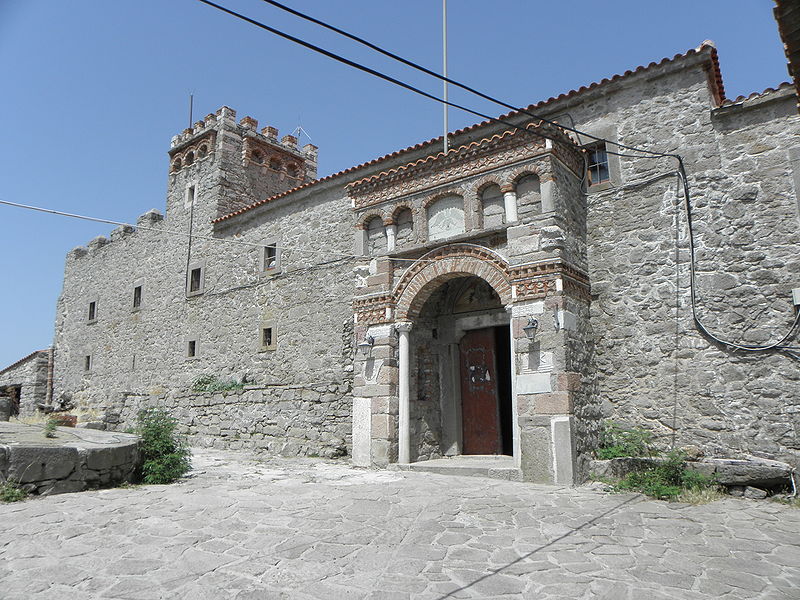
The oldest artifacts found on the island date to the Paleolithic period. Important archaeological sites on the island are the Neolithic cave of Kagiani, probably a refuge for shepherds, the Neolithic settlement of Chalakies, and the extensive habitation of Thermi (3000–1000 BC). The largest habitation is found in Lisvori (2800–1900 BC) part of which is submerged in shallow coastal waters. There are also several archaic, classical Greek and Roman remains. Vitruvius called the ancient city of Mytilene “magnificent and of good taste”. Remnants of its medieval history are three impressive castles.

Lesbos is the birthplace of several famous persons. In archaic times, Arion developed the type of poem called dithyramb, the progenitor of tragedy, and Terpander invented the seven note musical scale for the lyre. Two of the nine lyric poets in the Ancient Greek canon, Alcaeus and Sappho, were from Lesbos. Phanias wrote history. The seminal artistic creativity of those times brings to mind the myth of Orpheus to whom Apollo gave a lyre and the Muses taught to play and sing. When Orpheus incurred the wrath of the god Dionysus he was dismembered by the Maenads and of his body parts his head and his lyre found their way to Lesbos where they have “remained” ever since. Pittacus was one of the Seven Sages of Greece. In classical times Hellanicus advanced historiography, Theophrastus, the father of botany, succeeded Aristotle as the head of the Lyceum. Aristotle and Epicurus lived there for some time, and it is there that Aristotle began systematic zoological investigations. In later times lived Theophanes, the historian of Pompey’s campaigns, Longus wrote the famous novel Daphnis and Chloe, and much later the historian Doukas wrote the history of the early Ottoman Turks. In modern times the poet Odysseus Elytis, descendant of an old family of Lesbos received the Nobel Prize.
Source Wikipedia.